
Tile Work Built to Last on the Right Base
Tile installation in Salem, Albany, and the greater Oregon area for bathrooms, showers, and surfaces where failed subfloors cause cracking and grout failure
Tile on older homes fails at the grout lines and cracks at the field tiles, but the floor beneath it is usually the reason. Solid Line Remodeling Incorporated is a tile installer in the Salem, Albany, and the greater Oregon area whose core trade is tile, and the work begins with what is under the tile rather than the tile itself. Walk-in showers, bathroom floors, backsplashes, and kitchen surfaces are all in scope, and every project starts with a subfloor check and waterproofing review before setting begins.
The process moves from subfloor assessment to waterproofing membrane at wet areas, then to leveling, then to tile layout agreed on the walk-through, then to setting and grouting. In older homes in the Salem, Albany, and the greater Oregon area, where subfloors may flex or sit out of plane, skipping any of those steps in order is what produces the cracked grout and loose tiles that require replacement within a few years. Waterproofing membrane, subfloor preparation, grout, and trim are the items most often missing from a low bid, and they are the same items that determine whether a walk-in shower holds up or leaks behind the wall.
To understand exactly what a tile project on your property requires, schedule an on-site walk-through so subfloor and waterproofing conditions can be reviewed before a quote is built.
How Tile Installation Addresses Failure at the Source
Setting tile is a late step in a sequence that starts well before the first piece is placed. Once the subfloor is confirmed stable and the waterproofing membrane is installed at the shower pan and wet wall areas, a cement board or equivalent decoupling layer is fastened before mortar is applied. Tile is then set to the layout established during the walk-through, with consistent joint spacing maintained so grout lines are uniform and the pattern reads correctly at the walls and transitions.
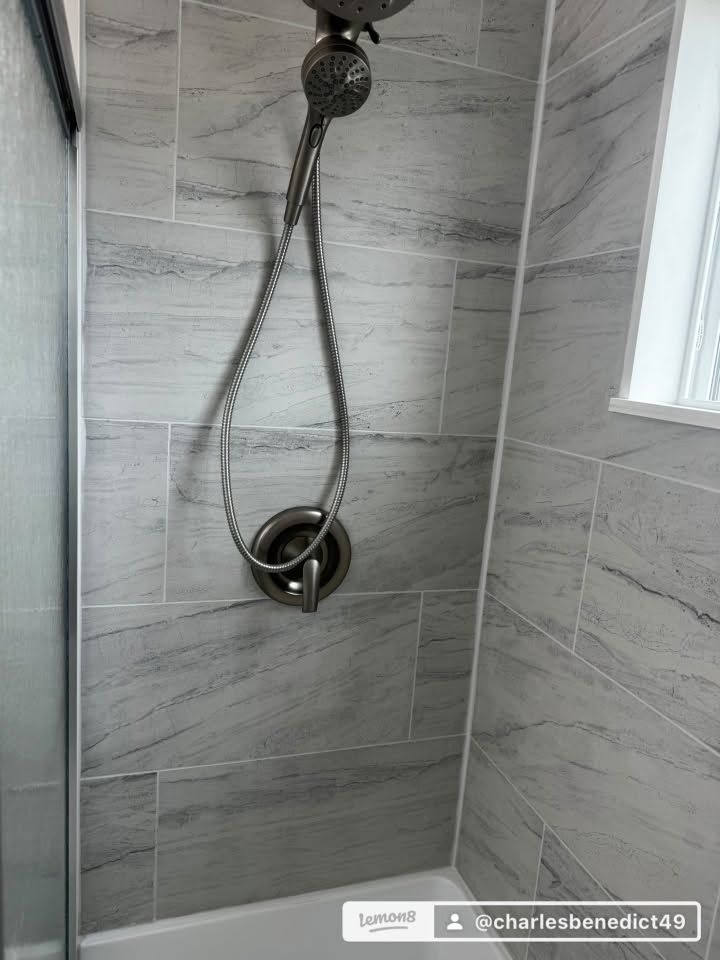
After grouting and curing, the surfaces that are finished are ones where grout lines sit flush and full, tile faces are flat across the field without lippage between adjacent pieces, and trim pieces cap edges cleanly so there are no exposed tile edges at thresholds or inside corners. Solid Line Remodeling Incorporated brings 25 years of tile and general contracting experience to each job, which means the sequencing decisions, including when to stop, correct, and continue, come from working through the conditions that older homes actually present rather than assuming a best-case subfloor.
When reviewing a tile quote, confirm that waterproofing membrane is called out explicitly for shower and wet area work, not implied. A quote that combines all labor under a single line makes it impossible to know whether that step is included, and it is the step most directly tied to whether a shower remains watertight over time.
Common Questions About This Service
The questions below address the tile installation process specifically, including what happens before tile is set, what the finished work should look like, and how property conditions affect the approach.
What is a waterproofing membrane, and why is it required in a walk-in shower?
A waterproofing membrane is a sheet or liquid-applied barrier installed over the shower pan and wet walls before tile is set. Without it, water that migrates through grout lines reaches the subfloor and framing behind the tile, which causes structural damage that is not visible until it is extensive.
How does tile layout get determined before setting begins?
Layout is agreed on during the walk-through so the pattern, grout joint width, and starting point are confirmed before any tile is cut or set. Starting from the center of a room or shower wall, rather than a corner, keeps cuts symmetrical and prevents small slivers at the most visible edges.
What causes grout to crack in a tile installation that is only a few years old?
Grout cracking is almost always caused by movement in the substrate below the tile. In Salem, Albany, and the greater Oregon area homes where subfloors flex or were not leveled before setting, the tile assembly moves with the floor, and grout, which is rigid, fractures at the joints before the tile itself cracks.
How should finished tile look when inspected at eye level?
Across a properly set field, there should be no lippage, meaning no tile edge should sit higher than the one adjacent to it. Grout lines should be consistent in width, fully filled without voids, and the same depth across the surface rather than sunken in some joints and proud in others.
What is included in a tile installation versus what is handled separately?
Setting, grouting, and trim are part of the tile work itself. Demolition of existing tile, plumbing rough-in for a new shower, and fixture installation are typically separate scopes that should be itemized distinctly in any quote so each component is accounted for.
Solid Line Remodeling Incorporated also does
tile installation in Salem, Albany, Stayton, Sweet Home, and Corvallis. To get a quote that accounts for subfloor conditions and waterproofing requirements at your property, arrange an on-site review before the project scope is finalized.